
Questions On Binary Search Tree
All of the below solutions is in continuation of the Binary search Tree program which is written with this post therefore I am not passing root to every method, it is referred from the BinarySeachTree class.
Problem 1: Write a program to print the nodes by levels.
For example in below tree it should print – 6,4,9,2,5,7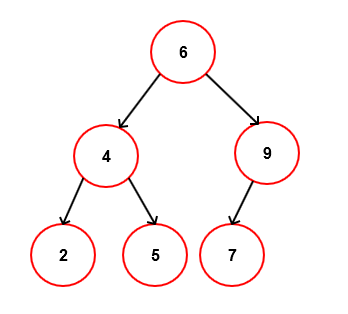
This is nothing but the Breadth First search. You will have to use a Queue to track the nodes.
 public void levelOrderTraversal() {
        Queue<Node> queue = new LinkedList<>();
        Node currNode = root;
        queue.add(currNode);
        while (!queue.isEmpty()) {
            currNode = queue.poll();
            System.out.print(currNode.value);
            if (null != currNode.left) {
                queue.add(currNode.left);
            }
            if (null != currNode.right) {
                queue.add(currNode.right);
            }
        }
        System.out.println();
    }
Problem 2: Write a program to check whether a tree is Binary Search Tree or not.
You just traverse node by node and check for the Binary Search Tree conditions.
 public boolean isBST(Node root) {
        Node curr = root;
        Stack<Node> stack = new Stack<>();
        stack.push(curr);
        while (!stack.isEmpty()) {
            Node node = stack.pop();
            if (node.left != null) {
                if (node.value > node.left.value) {
                    stack.push(node.left);
                } else {
                    return false;
                }
            }
            if (node.right != null) {
                if (node.value < node.right.value) {
                    stack.push(node.right);
                } else {
                    return false;
                }
            }
        }

        return true;
    }
Problem 3: Write a program to Find lowest common ancestor of two nodes.
For example in below tree – the lowest common ancestor for 2 and 5 will be 4, the lowest common ancestor for 4 and 7 will 6.
 public Node findLowestCommonAccestor(Node child1, Node child2) {
        if (root == null || child1 == null || child2 == null) {
            return null;
        }
        while (root != null) {
            int value = root.value;
            if (value > child1.value && value > child2.value) {
                root = root.left;
            } else if (value < child1.value && value < child2.value) {
                root = root.right;
            } else {
                return root;
            }
        }
        return null; // only if empty tree
    }
Problem 4: Write a program to compute the size of a Binary Search Tree.
We can easily define it recursively. It will be the sizeOf(left tree) + sizeOf(right tree) + 1 (root).
 public int sizeOfBinaryTree(Node root) {
        if (root == null) {
            return 0;
        } else {
            return (sizeOfBinaryTree(root.left) + 1 + sizeOfBinaryTree(root.right));
        }
    }
Problem 5: Write a program to find largest Binary Search Tree in a tree.
 public int largestBST(Node root) {
        if (isBST(root))
            return sizeOfBinaryTree(root);
        else
            return Math.max(largestBST(root.left), largestBST(root.right));
    }
Problem 5: Write a program to create mirror image of a Binary Search Tree.
 public Node mirrorOfBinaryTree(Node root) {
        Node temp = null;
        if (root != null) {
            mirrorOfBinaryTree(root.left);
            mirrorOfBinaryTree(root.right);
            temp = root.left;
            root.left = root.right;
            root.right = temp;
        }
        return root;
    }
Problem 6: Write a program to check whether a BST is mirror image of other BST.
 public boolean isMirror(Node root1, Node root2) {
        if (root1 == null && root2 == null) {
            return true;
        }
        if (root1 == null || root2 == null) {
            return false;
        }
        if (root1.value != root2.value) {
            return false;
        } else {
            return isMirror(root1.left, root2.right) && isMirror(root1.right, root2.left);
        }
    }
Problem 7: Write a program to find the height of a Binary Search Tree.
 public int findHeight() {
        Queue<Node> queue = new LinkedList<>();
        Node currNode = root;
        int level = 0;
        if (currNode == null) {
            return -1;
        }
        queue.add(currNode);
        queue.add(null);
        while (!queue.isEmpty()) {
            currNode = queue.poll();
            if (currNode != null) {
                if (currNode.left != null) {
                    queue.add(currNode.left);
                }
                if (currNode.right != null) {
                    queue.add(currNode.right);
                }
            } else {
                if (!queue.isEmpty()) {
                    queue.add(null);
                    level++;
                }
            }
        }
        return level;
    }
References
Design and Analysis of Algorithm – Anany Levitin
Beginning Algorithm – Simon Harris, James Ross
Data Structures And Algorithms In Java- Robert Lafore
Introduction_to_algorithms- Corman